

ROLE - SENIOR PRODUCT DESIGNER
RESPONSIBILITIES
UX Research
User Experience Strategy
Information Architecture
User Flows
Wireframing
Interface Design
Stakeholder Collaboration
TEAM
Product Manager
Engineering Team
Research Team
Content Team
Scientia is a digital research and economic intelligence platform designed to help professionals, analysts, researchers, and decision-makers access economic insights, datasets, publications, and expert content from a single ecosystem.
The challenge was to create a platform capable of organizing large volumes of information while enabling users to quickly discover, consume, and act on relevant insights.
Prototypes emphasized:
Clean, modern layout
Strong typographic hierarchy
Friendly, professional colors
Easy access to articles, datasets, and podcasts


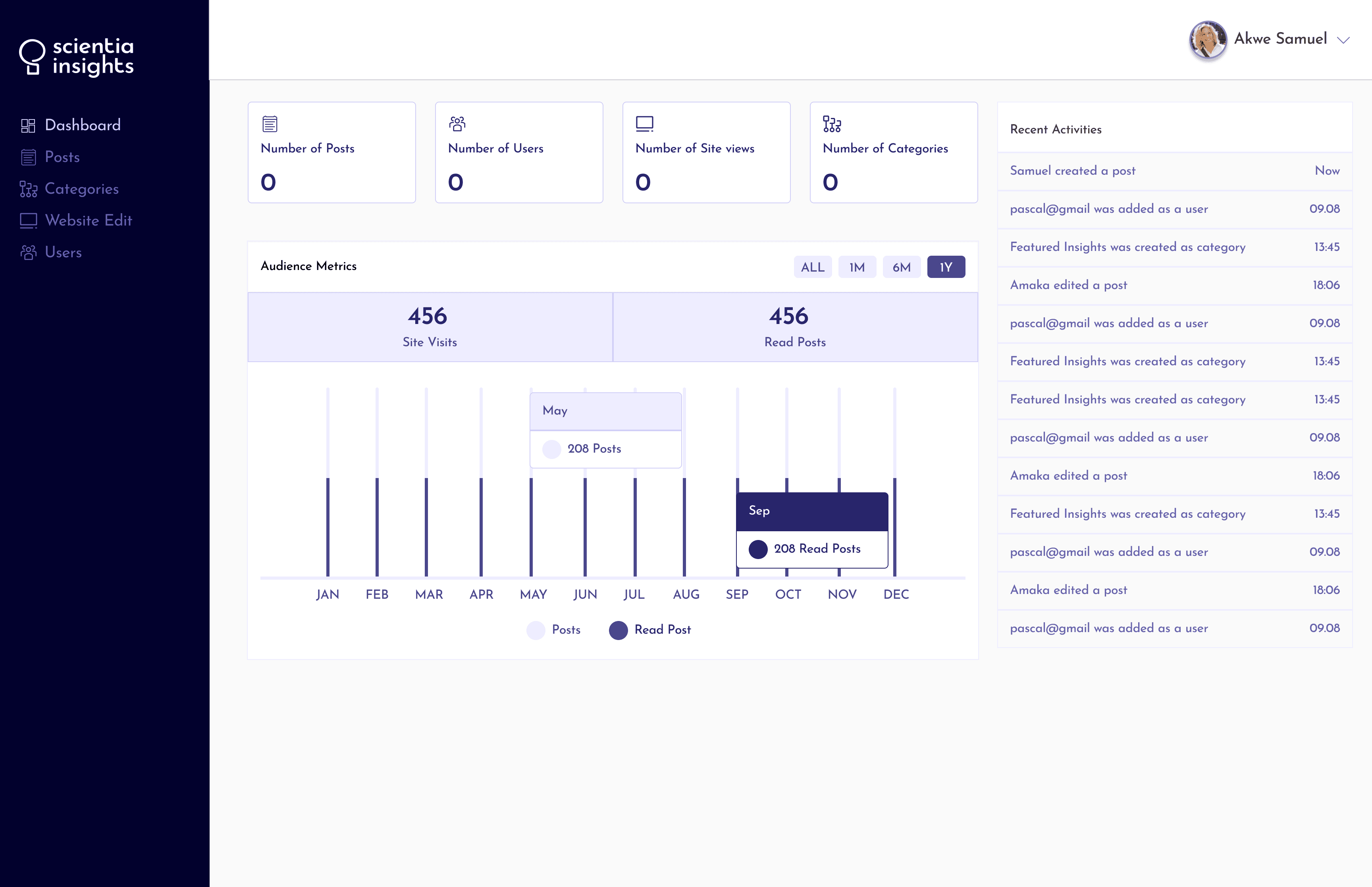


Research content was distributed across multiple channels, making it difficult for users to discover relevant information efficiently.
Users often struggled to navigate across datasets, reports, articles, and multimedia content, resulting in fragmented experiences and reduced engagement.
The organization needed a centralized platform capable of:
Improving content discoverability
Supporting multiple content formats
Simplifying data exploration
Encouraging continuous engagement

To better understand user behavior, I worked closely with stakeholders and conducted discovery activities.
Research Activities
User interviews
Stakeholder workshops
Competitive analysis
Content audits
Journey mapping
WHAT WE LEARNED
Information overload reduced engagement
Users often felt overwhelmed when presented with large volumes of content without clear pathways.
Navigation lacked context
Users struggled to understand how reports, datasets, and insights connected.
Search alone was insufficient
Users wanted guided discovery rather than relying solely on search functionality.
Different audiences had different goals
Researchers required depth and flexibility, while casual users preferred simplified access to insights.
DEFINING THE OPPORTUNITY
The opportunity was not simply to create another content platform.
The goal was to transform complex economic information into a structured and accessible digital experience.
Design Principles
Make discovery effortless
Reduce cognitive load
Create meaningful content relationships
Support both experts and casual users
SOLUTION STRATEGY
The design approach focused on three core areas:
Structured Information Architecture
A scalable framework was created to organize datasets, reports, articles, and multimedia content.
Guided Discovery
Content recommendations, categorization, and curated pathways helped users uncover relevant information.
Flexible Research Experience
Users could explore data through multiple entry points depending on their objectives and expertise.
DESIGNING THE EXPERIENCE
Building a Scalable Information Architecture
A clear content hierarchy was introduced to help users navigate complex information ecosystems.

Brainstorming focused on making complex economic information clear and navigable. We sketched layouts exploring category hierarchies, search UX, dataset exports, and multimedia integration.
Improving Content Discovery
New browsing experiences enabled users to discover relevant content through recommendations, categories, and thematic collections.

Competitive & Gap Analysis: We evaluated platforms such as McKinsey Insights and major academic databases, identifying key gaps including limited real-time data and a lack of contextual content breakdowns.
Simplifying Data Exploration
Datasets were redesigned with clearer visual structures, filtering mechanisms, and export capabilities.

Alongside the UI, I developed branding elements — including logo, color palette, and visual components — to communicate credibility and clarity.
OUTCOME
The redesigned platform provided a more intuitive research experience while supporting future content growth.
Business Impact
Improved content discoverability
Increased platform usability
Enhanced scalability for future content expansion
Strengthened knowledge-sharing capabilities
User Impact
Faster access to insights
Reduced navigation friction
Better understanding of relationships between content types
More efficient research workflows
REFLECTION
This project reinforced the importance of information architecture as a product strategy tool.
Users rarely struggle because information is unavailable. More often, they struggle because information is difficult to find, understand, and navigate.


