

TEAM
Product Manager
Engineers
Customer Support Team
Business Stakeholders
RESPONSIBILITIES
UX Research
Product Strategy
Information Architecture
User Flows
Wireframing
Interface Design
Stakeholder Collaboration
Glover is a digital marketplace that enables users to buy and sell gift cards and access digital financial services.
As gift card adoption grew, the purchase journey revealed a critical friction point: users were required to complete mandatory onboarding and activate a wallet before purchasing a gift card.
While this process helped the business capture customer information and enable wallet-based payments, it created unnecessary friction for users whose immediate goal was simply to purchase a gift card.
The project focused on
Redesigning the purchase journey to reduce drop-off
Improve gift card discovery
Balance a seamless user experience with business retention goals
Metrics
Before
After
Gift Card Purchase Completion
54%
+35% increase
Purchase Drop-off
46%
28% reduction
Payment Options
Wallet only
Wallet + Card + Transfer
Gift Card Discovery
Manual browsing
40% faster product discovery
Customer Information Capture
Wallet registration only
+45% increase in customer email capture
Repeat Purchase Rate
25%
+20% increase
Here's a preview of the redesigned flows and high-fidelity screens


Users who wanted to purchase gift cards were required to complete mandatory onboarding before they could access the wallet-powered payment flow.
While the wallet provided value for repeat transactions and broader financial services, requiring wallet activation upfront introduced friction for users with a single immediate goal: purchasing a gift card.
The existing journey required users to:
Create an account
Complete onboarding
Activate wallet
Fund wallet
Purchase gift card
This created a mismatch between user intent and product requirements, increasing drop-off during the purchase journey.
The mandatory wallet activation through onboarding created three major problems:
Increased Drop-off
Users who were only interested in purchasing a gift card abandoned the process when faced with onboarding requirements.
Limited Payment Flexibility
Purchasing a gift card did not require many of the onboarding steps being enforced.
Friction increased abandonment
Every additional step reduced the likelihood of transaction completion.

We reviewed user journeys, purchase behavior, and gift card transaction patterns.
Users were goal-driven
Most users were not looking to create a financial account first. They wanted immediate access to gift card purchases.
The wallet created unnecessary dependency
The wallet was useful for retention and repeat transactions, but it was not required for every purchase scenario.
Popular gift cards were difficult to find
The existing marketplace structure did not prioritize frequently purchased categories. Users had to browse through a less optimized structure.
The business still needed customer information
Removing onboarding created a new challenge: How do we maintain customer visibility without blocking conversion?
The opportunity was to create a purchase experience that satisfied both users and the business.
This led to four guiding principles:
DESIGN PRINCIPLES
Reduce friction
Allow users to complete their intended action faster.
Capture value progressively
Collect customer information at the right moment.
Improve product discovery
Make popular gift cards easier to find.
Increase payment flexibility
Support user-preferred transaction methods.
The redesign focused on three major improvements.
Removing Mandatory Wallet Activation
Users could now purchase gift cards without completing wallet activation. This reduced unnecessary friction and allowed users to experience value immediately.

Introducing Alternative Payment Methods
Because the wallet was no longer the only payment path, we introduced:
Bank Transfer
Card Payments
This allowed users to complete purchases using their preferred method.
The wallet remained available for users who wanted additional features and future transactions.


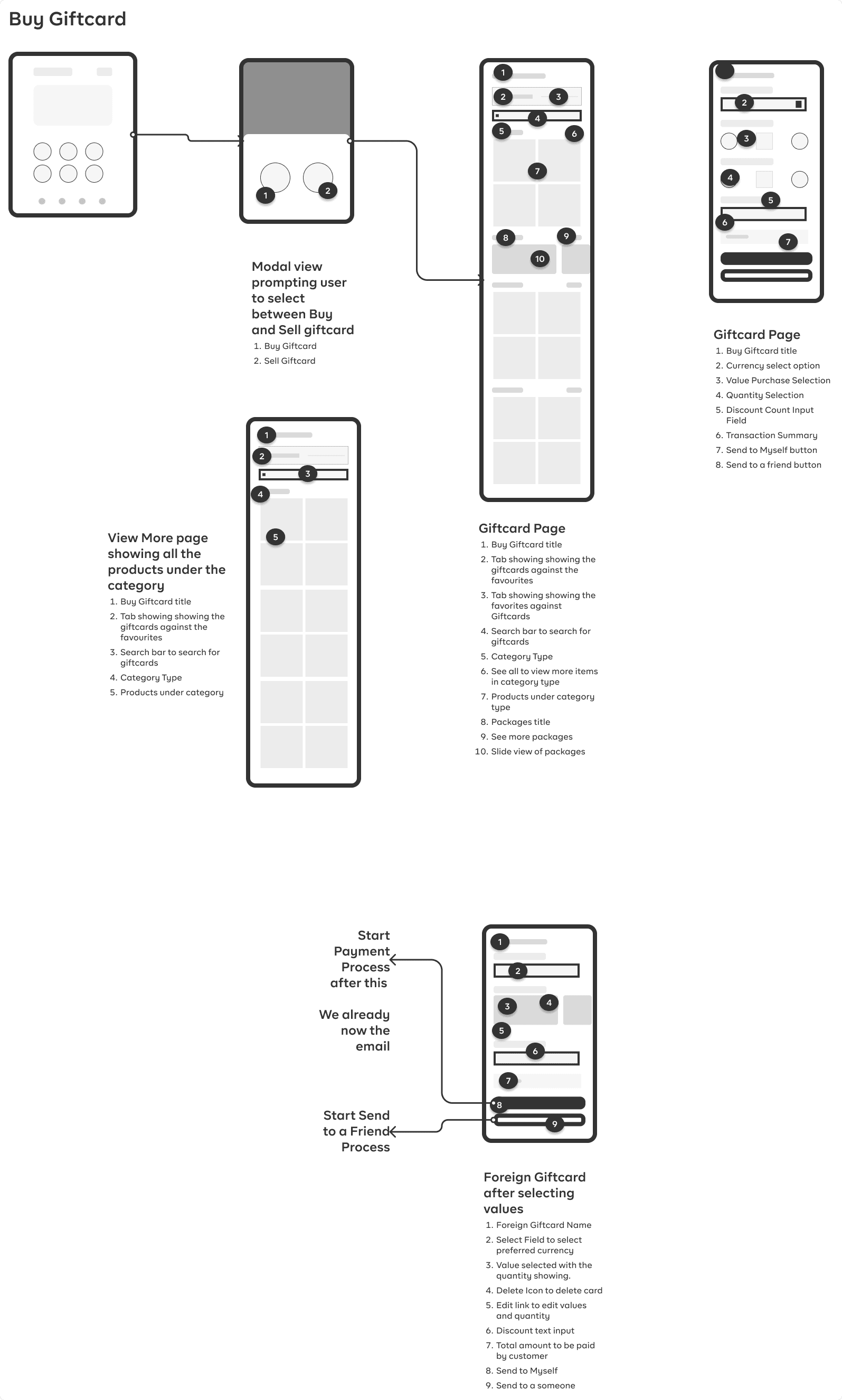
Improving Gift Card Discovery
We analyzed gift card purchase patterns and redesigned the marketplace structure around user behavior.
Changes included:
Improved categories
Better navigation
Prioritization of frequently purchased gift cards
Clearer product hierarchy
Users could find relevant gift cards faster.


Creating a Soft Onboarding Experience
Removing mandatory onboarding created a business challenge:
The company still needed customer information for:
Retention
Customer communication
User lifecycle management
Instead of forcing registration before value, we introduced a lighter approach.
Users provided email information during the purchase journey.
This created a balance:
Users received:
Faster checkout
Less friction
Immediate value
Business received:
Customer identification
Retention opportunities
Marketing touchpoints

The redesign transformed gift card purchase from an account-first journey into a value-first experience.
Business Impact
Increased gift card purchase completion
Reduced onboarding-related drop-off
Increased payment flexibility
Improved customer data capture
Improved marketplace engagement
User Impact
Faster purchasing experience
Easier gift card discovery
More payment choices
Reduced friction
This project reinforced that onboarding should not always be the first step in a customer journey.
A successful product experience requires understanding the user's immediate goal and finding the right balance between business requirements and user expectations.
By replacing mandatory onboarding with progressive customer identification, we created an experience that improved conversion while still supporting long-term customer relationships.


